DGX Spark vs Mini PC AMD (Strix Halo) vs Mac mini: the local AI duel 2026
NVIDIA DGX Spark, AMD Strix Halo mini PC, Mac mini M4: compared field by field for local AI.
~ 14 min read
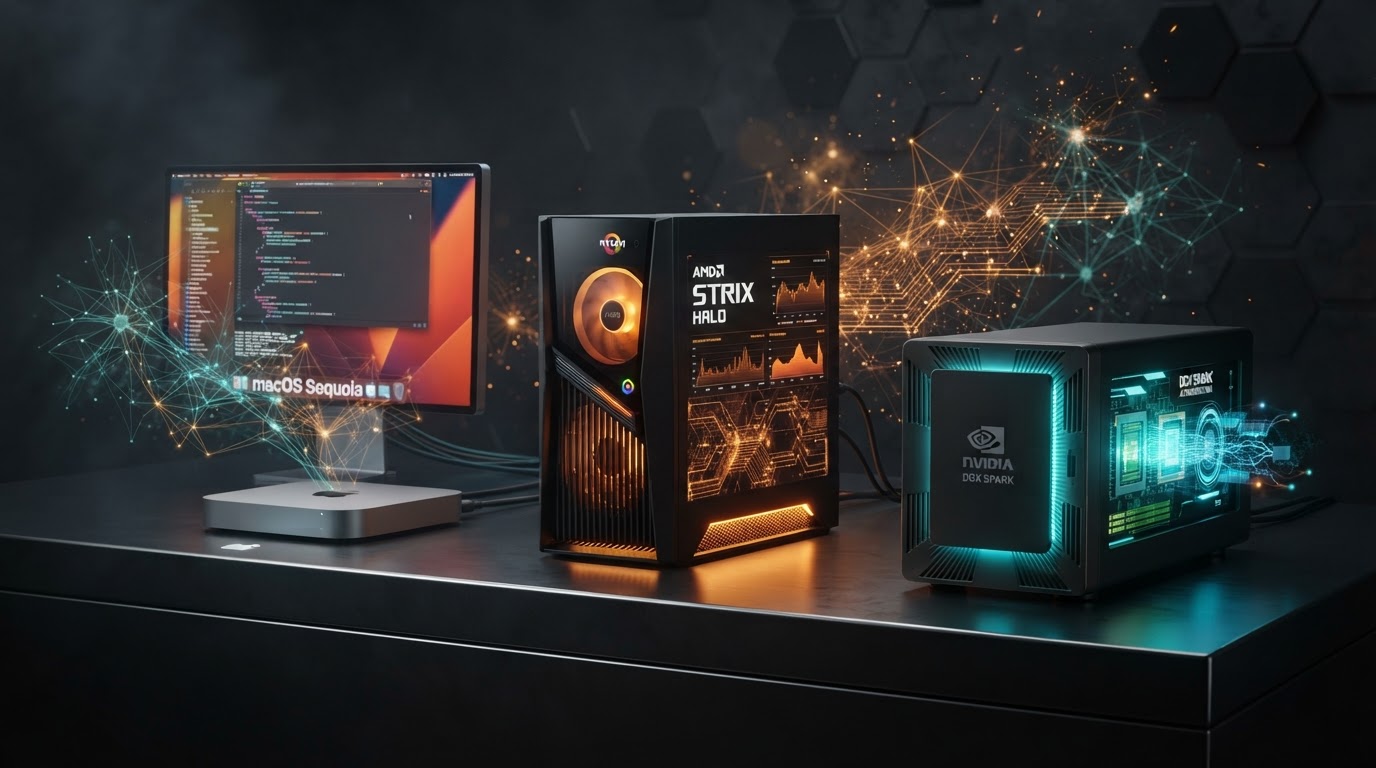
2026 brought a new category to local AI: the "personal AI supercomputer in a small box." Three contenders claim that title — NVIDIA DGX Spark, the new AMD Strix Halo mini PCs (e.g. GMK/Fronix), and the Mac mini M4. All three are compact, powerful, and sold as "run serious AI at home." But they take radically different approaches. Here's the field-by-field comparison.
The contenders
NVIDIA DGX Spark
NVIDIA's personal AI workstation. It's essentially a compact machine built around a custom NVIDIA SoC (GB10 "Grace" + Blackwell GPU) with 128 GB of unified LPDDR5X memory and ~273 GB/s of bandwidth. It ships with the full NVIDIA software stack: CUDA, NIMs, a personal DGX OS. The pitch: the CUDA ecosystem and large unified memory, in a quiet desktop box.
- Memory: 128 GB unified, 273 GB/s
- Compute: ~1 PFLOPS FP4 (Blackwell)
- Ecosystem: full CUDA — the big differentiator
- Price: ~$4,000 (launch)
AMD Strix Halo mini PC (e.g. GMK, Fronix)
The new AMD "Halo" APUs (Strix Halo, Ryzen AI Max+ 395) integrate a 16-core Zen 5 CPU and a huge RDNA 3.5 iGPU with up to 128 GB of shared LPDDR5X and up to ~256 GB/s. The pitch: the Mac's unified-memory trick, but on x86 with Windows/Linux, and at a lower price. No CUDA, but ROCm support and llama.cpp/Vulkan.
- Memory: up to 128 GB shared LPDDR5X, ~256 GB/s
- Compute: iGPU, no discrete GPU
- Ecosystem: x86, Windows/Linux, ROCm (still young for inference)
- Price: ~$1,500-2,500 depending on RAM
Apple Mac mini M4 Pro/Max
The reference for unified memory. M4 Max = up to 128 GB unified, 546 GB/s; M4 Pro = up to 64 GB, 273 GB/s. MLX framework, macOS. No CUDA. The mature option for large-model inference at home.
- Memory: up to 128 GB unified (M4 Max), 546 GB/s
- Compute: M4 Max GPU, ~27 TFLOPS FP16
- Ecosystem: macOS, MLX, llama.cpp/Metal
- Price: ~$1,800-3,500 depending on the chip/RAM
Field-by-field comparison
| Criterion | DGX Spark | Strix Halo mini PC | Mac mini M4 |
|---|---|---|---|
| Max memory | 128 GB unified | 128 GB shared | 128 GB unified (M4 Max) |
| Memory bandwidth | 273 GB/s | ~256 GB/s | 546 GB/s |
| CUDA / NVIDIA stack | Yes (full) | No | No |
| Training / fine-tuning | Yes (CUDA) | Limited (ROCm) | Limited (MLX) |
| Noise | Quiet | Quiet | Silent |
| Power | ~150 W | ~120 W | ~150 W (M4 Max) |
| OS | DGX OS (Linux) | Windows / Linux | macOS |
| Indicative price | ~$4,000 | ~$1,500-2,500 | ~$1,800-3,500 |
Indicative LLM benchmarks (llama.cpp, Q4 where possible)
| Model | DGX Spark | Strix Halo 128 GB | Mac mini M4 Max 128 GB |
|---|---|---|---|
| Llama-3-8B Q4 | ~80 tok/s | ~30 tok/s | ~60 tok/s |
| Llama-3-70B Q3 | ~18 tok/s | ~8 tok/s | ~22 tok/s |
| Llama-3-120B Q2 | ~7 tok/s | ~4 tok/s | ~10 tok/s |
The Mac wins on bandwidth and therefore on throughput for large models. The DGX Spark wins on ecosystem (CUDA) and therefore on training. Strix Halo is the budget option, but its iGPU is no match for either in raw compute.
Who is each for?
| Your profile | Best choice |
|---|---|
| I want to train / fine-tune at home | DGX Spark (CUDA) |
| I want max throughput on big models, silent | Mac mini M4 Max 128 GB |
| I want 70B+ at the lowest price | Strix Halo 128 GB mini PC |
| I want the full NVIDIA stack without a rack | DGX Spark |
| I want to develop & ship, not train | Mac mini (MLX) or Strix Halo (x86) |
The honest verdict
- DGX Spark = the only one with real CUDA — irreplaceable for training and for the NVIDIA-native toolchain. But $4k and comparable inference throughput to the Mac.
- Mac mini M4 Max = the throughput champion for inference of large models, silent, at a fair price. But no CUDA, no training beyond LoRA.
- Strix Halo mini PC = the cheapest gateway to 128 GB of usable memory, on x86. But weaker compute and a still-young ROCm inference stack.
For pure inference of large models at home, the Mac mini M4 Max 128 GB remains the best quality/price/silence compromise. For training, the DGX Spark's CUDA is the decisive factor. To go deeper on the Mac specifically, see the dedicated guide.